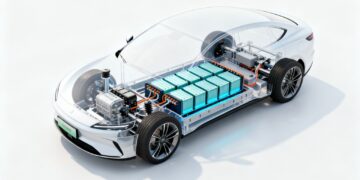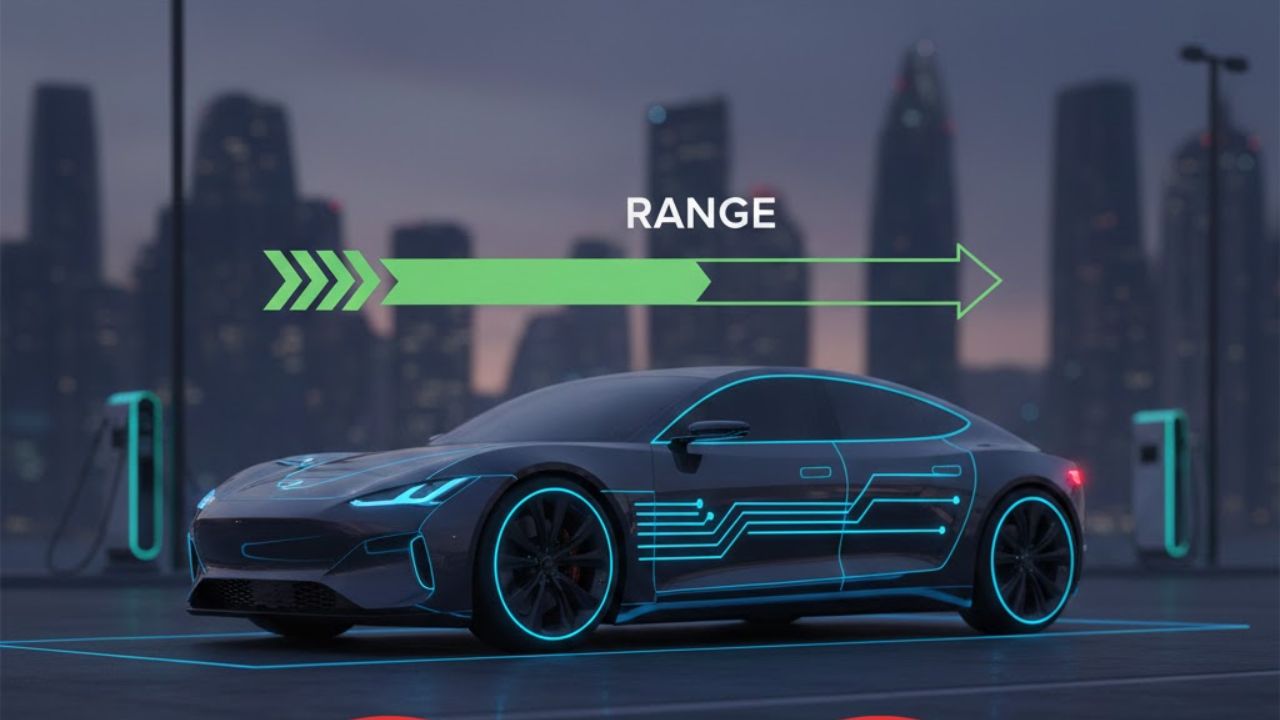
Range anxiety has long been one of the primary obstacles preventing widespread consumer transition from internal combustion engine (ICE) vehicles to electric vehicles (EVs). While early-generation electric cars barely cleared 100 miles on a single charge, modern electric vehicles regularly exceed 300 to 500 miles. This massive leap in capability is not an accident. It is the direct output of billions of dollars poured into specialized automotive research and multi-disciplinary engineering.
Extending the driving range of an electric vehicle involves much more than simply stuffing a larger battery underneath the floorboards. In fact, adding heavier battery packs rapidly yields diminishing returns due to the added mass. True efficiency breakthroughs stem from a holistic system-level approach that harmonizes battery chemistry, vehicle aerodynamics, powertrain efficiency, intelligent software management, thermal regulation, and structural packaging.
1. Breakthroughs in Next-Generation Battery Chemistry
At the heart of the electric vehicle revolution lies the battery cell. Automakers and materials science laboratories worldwide are aggressively researching advanced chemical compositions to maximize gravimetric and volumetric energy density.
A higher energy density means storing more kilowatt-hours (kWh) of power without adding excessive physical weight or occupying valuable cabin space.
Key Advances in Cell Electrochemistry
A. Solid-State Battery Architectures: Traditional lithium-ion batteries rely on flammable liquid electrolytes to transport ions between the cathode and anode. Automotive research is rapidly advancing solid-state batteries, which utilize solid ceramic, glass, or polymer electrolytes. This change dramatically improves safety, prevents thermal runaway, and allows the use of pure lithium metal anodes, potentially increasing energy density by 50% to 100%.
B. Silicon-Enhanced Anodes: Conventional battery anodes are constructed primarily from graphite. Researchers have discovered that replacing or blending graphite with silicon enables the anode to hold up to ten times more lithium ions by atomic ratio. Advanced nano-engineered silicon structures prevent the material from swelling and degrading during charging cycles, unlocking higher energy storage in compact battery footprints.
C. Refined Lithium Iron Phosphate (LFP) Formulations: While LFP chemistry historically offered lower energy density than nickel-manganese-cobalt (NMC) cells, extensive engineering has dramatically closed the gap. LFP cells eliminate expensive cobalt and nickel, offer superior thermal stability, and endure significantly higher charge-discharge cycles, making long-range entry-level EVs commercially viable.
D. Emerging Sodium-Ion Alternatives: For urban and short-range mobility, automotive researchers are refining sodium-ion technology. Sodium is abundant and low-cost. While it carries a lower energy density than premium lithium chemistries, it provides exceptional sub-zero temperature resilience and frees supply chains from critical mineral bottlenecks.
| Battery Technology | Typical Energy Density (Wh/kg) | Commercial Maturity | Key Advantage |
| Standard NMC (Lithium-Ion) | 240 – 300 Wh/kg | High (Current Standard) | High power output & established supply chain |
| Advanced LFP (Cell-to-Pack) | 160 – 210 Wh/kg | High (Growing Rapidly) | Lower production cost & extreme durability |
| Silicon-Anode Hybrid | 300 – 380 Wh/kg | Moderate (Early Adoption) | Accelerated fast-charging & higher density |
| Solid-State (Lithium-Metal) | 400 – 500+ Wh/kg | Emerging (Pilot Testing) | Maximum safety & transformative range gains |
2. Aerodynamic Refinement and Structural Lightweighting
At highway speeds, over 50% of an electric vehicle’s energy consumption goes directly toward overcoming aerodynamic drag. Unlike internal combustion engines, which waste substantial energy as heat, electric drivetrains convert over 85% of grid energy into motion. Consequently, aerodynamic drag impacts an EV’s real-world range far more drastically than a gasoline car.
Total Vehicle Drag Force = 0.5 × Dynamic Air Density × Drag Coefficient (Cd) × Frontal Area × (Velocity)²
Aerodynamic Engineering Innovations
A. Teardrop Body Architecture: Automakers utilize computational fluid dynamics (CFD) supercomputing alongside physical wind tunnel testing to design ultra-sleek vehicle profiles. Modern long-range EVs achieve drag coefficients ($C_d$) as low as 0.19 to 0.21, significantly lower than traditional sedans (0.28 to 0.35).
B. Active Aerodynamic Elements: Research into adaptive active aero allows vehicles to continuously adjust to driving conditions. Active front grille shutters close at high speeds to smooth airflow, active rear diffusers extend dynamically, and air suspension lowers the chassis height automatically to reduce underbody air turbulence on highways.
C. Digital Side Mirrors and Flush Door Handles: Eliminating protruding traditional side mirrors in favor of compact camera stalks reduces drag and wind noise. Retractable flush door handles preserve smooth laminar airflow along the vehicle flanks.
D. Aero-Optimized Wheel Covers and Underbody Panels: Rotating wheels create massive turbulent eddies. Specialized aero-wheels and fully sealed smooth underbody belly pans streamline air movement, recovering up to 15 to 20 miles of usable highway range.
Key Takeaway: Reducing a vehicle’s drag coefficient ($C_d$) by just 0.01 can extend real-world highway driving range by approximately 2.5%, proving that subtle visual tweaks deliver huge energy savings.
Lightweight Materials Science
Because battery packs are inherently heavy, automotive engineers use lightweight materials across the vehicle frame to offset the pack weight.
A. Gigacasting and Single-Piece Aluminum Structurals: By replacing hundreds of individual stamped metal parts with massive single-piece cast aluminum modules, automakers dramatically reduce chassis weight while simultaneously increasing structural rigidity.
B. High-Strength Carbon Fiber and Composite Composites: Utilizing carbon-fiber-reinforced polymers (CFRP) in safety cells and cross-members offers incredible strength-to-weight ratios, directly lowering overall vehicle curb weight.
C. Tailored Ultra-High-Strength Steels (UHSS): Advanced steel alloys allow thinner structural pillars and crossbeams that maintain top-tier crash safety ratings without adding unnecessary mass.

3. Advanced Thermal Management Systems (BTMS)
Batteries operate efficiently only within a narrow thermal window, typically between 20°C and 35°C (68°F to 95°F). Extreme heat accelerates chemical degradation, while extreme cold dramatically slows lithium-ion mobility, slashing usable driving range by up to 30% or more during winter months.
Automotive research into Battery Thermal Management Systems (BTMS) has transformed climate regulation from an energy-draining necessity into an integrated efficiency advantage.
                 ┌─────────────────────────────────────────┐
                 │        Ambient Temperature Extremes     │
                 │          (-20°C Winter / +45°C Summer)   │
                 └────────────────────┬────────────────────┘
                                      │
                                      ▼
                 ┌─────────────────────────────────────────┐
                 │    Integrated BTMS & Octovalve Control   │
                 └──────┬───────────────────────────┬──────┘
                        │                           │
                        ▼                           ▼
┌───────────────────────────────┐   ┌───────────────────────────────┐
│     Heat Pump & Waste Heat    │   │   Direct Liquid / Immersion   │
│          Recovery             │   │       Cooling Channels        │
└───────────────┬───────────────┘   └───────────────┬───────────────┘
                │                                   │
                └───────────────────┬───────────────┘
                                    │
                                    ▼
                 ┌─────────────────────────────────────────┐
                 │   Optimal Battery Temperature Window    │
                 │               (20°C – 35°C)             │
                 └─────────────────────────────────────────┘
Modern Thermal Innovations
A. Reversible Heat Pump Systems: Older EVs relied on resistive PTC heaters, which consume immense electrical power directly from the main traction battery. Modern EVs utilize multi-source heat pumps that extract ambient thermal energy from outside air and reroute it to heat the cabin and battery pack, preserving critical driving range in sub-zero climates.
B. Waste Heat Scavenging: Integrated thermal management systems collect waste heat generated by electric motors, power electronics, and high-speed DC fast-charging cycles. Instead of venting this thermal energy into the atmosphere, the system reroutes it to warm cold battery cells or precondition the pack prior to fast charging.
C. Direct Liquid Micro-Channel and Immersion Cooling: Rather than relying on simple air cooling, cutting-edge battery packs feature ultra-thin aluminum cooling plates running directly between individual battery cells. Immersion cooling—where cells are immersed in dielectric fluid—provides instantaneous heat dissipation during aggressive driving or ultra-fast charging.
4. High-Efficiency Powertrains and Silicon Carbide (SiC) Inverters
The powertrain converts stored direct current (DC) electrical energy from the battery into mechanical rotational energy at the wheels. Even minor percentage gains in drivetrain efficiency yield noticeable range improvements across tens of thousands of miles.
Breakthroughs in Power Electronics and Motors
A. Silicon Carbide (SiC) and Gallium Nitride (GaN) Semiconductors: Traditional EV inverters used silicon-based IGBT switches. Replacing standard silicon with wide-bandgap Silicon Carbide (SiC) semiconductors reduces energy conversion losses in the inverter by up to 70% to 80%. Because SiC operates at significantly higher voltages, frequencies, and temperatures, it increases total drivetrain efficiency by 5% to 10%, directly extending real-world driving range.
B. Dual-Motor Disconnect Systems: All-Wheel Drive (AWD) electric vehicles typically feature separate motors on the front and rear axles. Automotive research has introduced mechanical disconnect clutches that physically uncouple the secondary motor when cruising at steady speeds. This eliminates magnetic drag losses and converts the vehicle to high-efficiency single-motor drive instantly.
C. Axial Flux Motor Technology: While traditional radial flux motors are long and heavy, axial flux motors feature magnetic flux parallel to the axle rotation axis. They offer pancake-thin footprints, up to double the torque density, and higher energy efficiency across varying operational speeds.
D. Multi-Speed Electric Transmissions: While most EVs utilize a single-speed direct reduction gearbox, multi-speed transmissions (such as two-speed setups) allow the electric motor to operate in its sweetest efficiency band during high-speed highway cruising without sacrificing low-speed launching torque.
5. Intelligent Software, AI Control, and Energy Recovery
Hardware engineering sets the physical performance ceiling of an electric vehicle, but software intelligence determines how close the vehicle gets to that ceiling in real-world driving conditions. Modern electric vehicles function as software-defined machines that continuously calculate energy distribution.
Software and Predictive Range Optimization
A. Predictive Energy Management Algorithms: By integrating real-time GPS elevation profiles, live traffic conditions, ambient weather metrics, and wind speeds, onboard navigation software dynamically calculates precise energy consumption. The system adjusts power delivery and thermal preconditioning schedules to ensure maximum efficiency along the journey.
B. Adaptive Regenerative Braking: Regenerative braking transforms kinetic energy back into electrical energy during deceleration. Advanced software uses front radar, cameras, and vehicle sensors to adjust regenerative braking resistance automatically based on the distance to the vehicle ahead or upcoming speed zone changes.
C. Over-the-Air (OTA) Efficiency Calibration: Automotive software engineers continuously refine motor control algorithms, battery management software, and thermal control maps. Vehicle owners routinely receive OTA software updates that unlock additional driving range, faster charging curves, and improved energy recovery without requiring physical hardware modifications.
D. Driver Eco-Coaching and Haptic Feedback: Real-time feedback displays educate drivers on how their acceleration, speed, and braking habits impact battery drain. Subtle haptic accelerator pedal resistance encourages smoother, highly efficient driving choices.
6. Structural Battery Design: Cell-to-Pack (CTP) and Cell-to-Chassis (CTC)
Early electric vehicle architectures used a modular layout: individual battery cells were wired into modules, which were then placed inside a heavy protective battery tray, which was ultimately bolted into the vehicle frame. This multi-layered design wasted significant volume and added unnecessary weight.
TRADITIONAL PACK DESIGN:
[Individual Cell] ──> [Module Enclosure] ──> [Heavy Pack Frame] ──> [Vehicle Chassis]
(Low Volumetric Efficiency: ~40%)

MODERN CELL-TO-CHASSIS (CTC) DESIGN:
[Optimized Structural Cell] ─────────────────────────────────────────> [Integrated Chassis Floor]
(High Volumetric Efficiency: ~65-70%)
Architectural Engineering Evolution
A. Cell-to-Pack (CTP) Packaging: CTP architecture bypasses intermediate modules completely. Individual long-format prismatic or pouch cells fit directly into a unified outer pack structure. This eliminates up to 40% of internal wiring, connectors, and structural dividers, allowing engineers to pack significantly more active energy-storing chemistry into the exact same physical footprint.
B. Cell-to-Chassis (CTC) / Structural Battery Integration: The ultimate evolution of pack architecture turns the battery pack itself into a load-bearing structural component of the vehicle chassis. The top cover of the battery pack serves as the cabin floorboards. By making the battery cells carry structural loads, overall vehicle weight drops significantly while structural torsional rigidity increases.
C. Modular Scalability Platforms: Shared flexible platforms allow manufacturers to scale battery pack sizes seamlessly depending on customer range needs, minimizing manufacturing complexity and lowering the cost per kilowatt-hour.
7. Real-World Driving Range vs. Regulatory Test Cycles
Understanding electric vehicle range requires recognizing the differences between standardized regulatory testing cycles and actual highway driving conditions.
A. EPA Cycle (United States): The Environmental Protection Agency test includes multi-cycle testing that accounts for city and highway driving alongside air conditioning usage. It generally yields the most conservative and realistic real-world range estimates.
B. WLTP Cycle (Europe): The Worldwide Harmonized Light Vehicles Test Procedure uses dynamic driving profiles with higher average speeds. WLTP range figures are typically 10% to 20% higher than EPA estimates.
C. CLTC Cycle (China): The China Light-Duty Vehicle Test Cycle places heavy emphasis on low-speed city driving and heavy urban traffic. Consequently, CLTC range ratings are the most optimistic, often exceeding real-world highway range by 25% or more.
D. The Impact of Highway Speed and Temperature: Driving an EV at 75 mph (120 km/h) demands vastly more energy than city driving at 35 mph due to exponential aerodynamic drag forces. Combined with sub-freezing temperatures, real-world highway range can drop noticeably below advertised sticker ratings.
Summary of Range-Extending Automotive Research
                      ┌─────────────────────────────────┐
                      │    Automotive Research & Dev    │
                      └────────────────┬────────────────┘
                                       │
      ┌──────────────────┬─────────────┴──────┬──────────────────┐
      ▼                  ▼                    ▼                  ▼
┌───────────┐      ┌───────────┐        ┌───────────┐      ┌───────────┐
│ Chemistry │      │ Aerodynamics│      │ Thermal   │      │ Software  │
│  & Anodes │      │ & Materials │      │ Heat Pump │      │  & SiC    │
└─────┬─────┘      └─────┬─────┘        └─────┬─────┘      └─────┬─────┘
      │                  │                    │                  │
      └──────────────────┼────────────────────┴──────────────────┘
                         │
                         ▼
        ┌──────────────────────────────────┐
        │ Extended Real-World EV Range     │
        │ (500+ Miles / 800+ Kilometers)   │
        └──────────────────────────────────┘
The future of electric mobility is being defined by compounding efficiency gains across every layer of vehicle engineering:
A. Solid-State & Silicon Chemistry: Unlocking massive gravimetric energy density gains while accelerating ultra-fast charging capability.
B. Streamlined Aerodynamics: Minimizing drag through active aerodynamics, smooth underbody designs, and teardrop vehicle silhouettes.
C. Intelligent Thermal Management: Capturing waste heat via heat pumps to protect battery health in extreme cold and hot environments.
D. Silicon Carbide Electronics: Reducing conversion losses in the inverter to maximize power delivery from the battery to the wheels.
E. Structural Chassis Integration: Eliminating redundant packaging weight through Cell-to-Chassis structural design.
Through continuous multidisciplinary research, automakers are transforming electric vehicles from urban commuter cars into long-distance cruisers capable of replacing fossil-fuel transportation permanently.