In an era where the boundaries of classical physics are being relentlessly challenged, a groundbreaking convergence is taking place. The enigmatic world of quantum mechanics is no longer confined to theoretical labs or futuristic computing concepts; it is now actively revolutionizing one of humanity’s oldest and most fundamental pursuits: engine design. The advent of quantum computing is providing unprecedented tools to conceptualize, simulate, and design ultra-efficient engines that operate on principles defying our classical intuition. This is not merely an incremental improvement but a paradigm shift, promising to redefine the limits of efficiency, sustainability, and performance in energy conversion. This deep dive explores how quantum computational models are crafting the blueprint for the next generation of power systems, the profound scientific principles at play, and the tangible implications for our energy-intensive world.
A. Deconstructing the Classical Ceiling: The Thermodynamic Limit
To appreciate the quantum leap, one must first understand the constraints of classical engine design. For centuries, since the days of steam engines, our power generators have been governed by the venerable laws of thermodynamics. The pinnacle of this framework is the Carnot efficiency, a theoretical maximum that depends solely on the temperature difference between a heat source and a sink. No classical engine, no matter how exquisitely crafted, can surpass this limit. Friction, waste heat, and material limitations further erode practical performance, leaving a significant gap between theoretical ideals and real-world output. This ceiling has prompted scientists to look beyond the classical realm for answers, turning to the counterintuitive but potent phenomena of quantum physics.
B. The Quantum Toolkit: Entanglement, Superposition, and Coherence
Quantum computing does not just offer “faster calculation” for traditional problems. It provides a native language to model systems that are inherently quantum. When applied to engine design, this involves harnessing unique quantum properties:
-
Quantum Superposition: A quantum system, like a synthesized atom or a constrained electron, can exist in multiple energy states simultaneously. This allows a theoretical “quantum working fluid” to explore multiple pathways for energy conversion at once, potentially finding more optimal routes than classical sequential processes.
-
Quantum Entanglement: This “spooky action at a distance” creates profound correlations between particles. In an engine context, components can become entangled, meaning the state of one instantly influences the state of another, regardless of separation. This could enable perfectly synchronized, lossless energy transfer within the system, eliminating inefficiencies stemming from poor coordination.
-
Quantum Coherence and Tunneling: Coherence refers to maintaining a well-defined quantum phase, while tunneling allows particles to penetrate energy barriers. Together, they could enable energy transfer mechanisms that bypass resistive classical pathways, effectively allowing work to be performed without the typical associated losses.
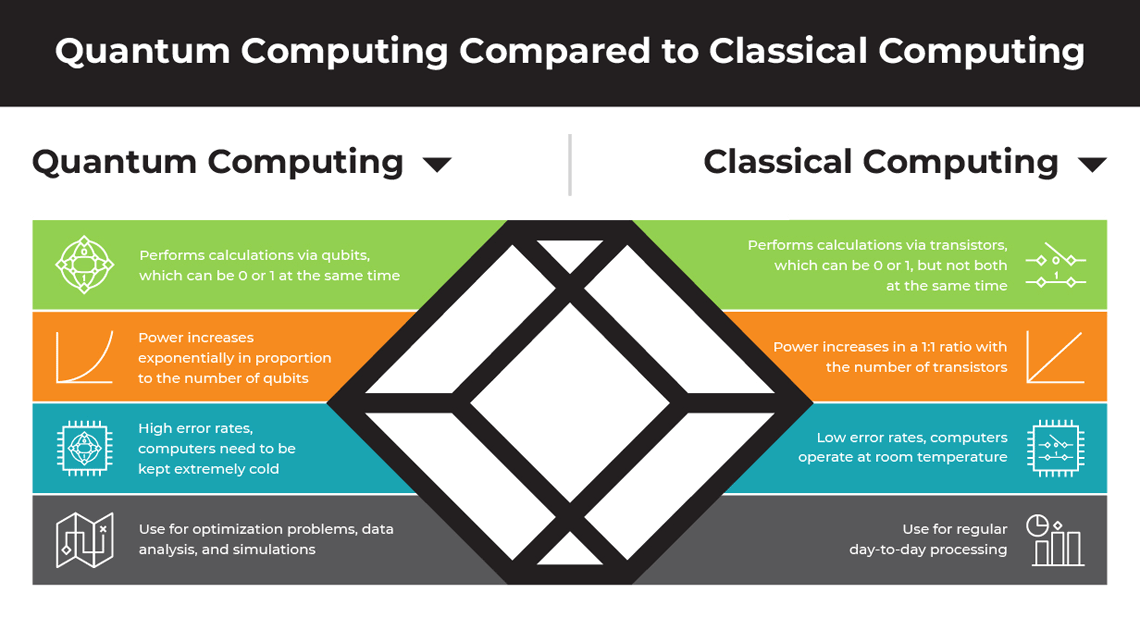
A quantum computer excels at simulating systems where these properties are dominant. By designing and testing virtual quantum engine models within its own quantum architecture, it can explore design spaces that are utterly intractable for even the most powerful supercomputers based on classical silicon.
C. Blueprinting the Future: Key Quantum Engine Archetypes
Through quantum simulation, several provocative engine designs have emerged from theoretical physics into tangible models. These are not engines with pistons and cylinders, but refined, micro- or nano-scale systems for converting energy at the quantum level.
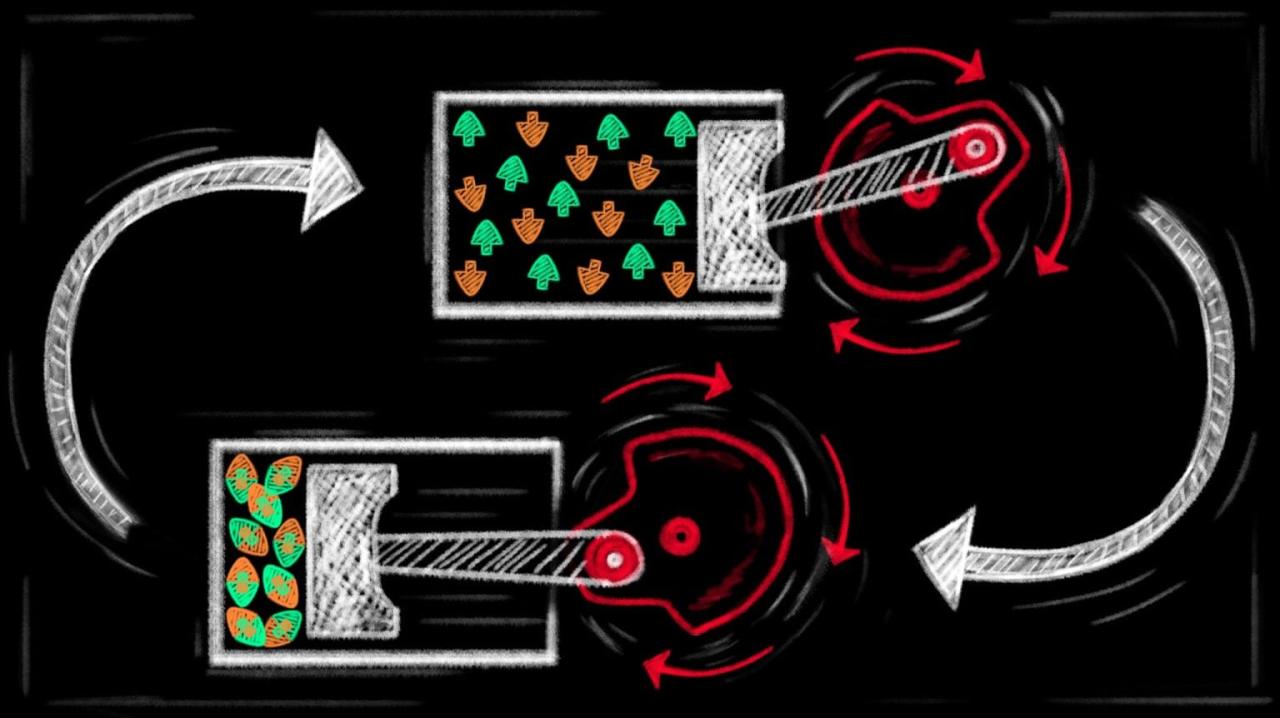
A. The Quantum Otto Cycle: This is the quantum analog of a familiar gasoline engine cycle. Here, the “working fluid” is a quantum bit or a two-level system (like an artificial atom). The cycle stages involve changing external parameters (like magnetic fields) to manipulate the quantum state’s energy levels. The power stroke occurs through a quantum adiabatic process, where the populations of energy levels shift, extracting work. Quantum coherence can be harnessed during this cycle to perform work that exceeds the classical bound for the same operational framework.
B. Measurement-Fueled Engines: One of the most radical concepts leverages a core quantum principle: the act of measurement itself disturbs the system. In these designs, carefully timed quantum measurements on a particle (like its spin) provide the “fuel.” The measurement collapses the superposition, releasing energy that can be harnessed as work. This turns a fundamental quantum phenomenon often seen as a nuisance into a powerful driver for an engine.
C. Quantum Heat Pumps and Refrigerators: Beyond prime movers, quantum principles are being applied to cooling. These designs use quantum correlations (entanglement) to create more efficient refrigerators at the micro-scale. They could be crucial for cooling the very quantum computers that design them, as well as for advanced sensors and quantum communication hardware, creating a self-sustaining technological ecosystem.
D. Coherent-Tunneling Engines: These models exploit quantum tunneling through energy barriers. Particles can “tunnel” from a high-energy state to a low-energy state through a barrier that would be impenetrable classically, directly converting potential energy into usable work in a highly efficient, non-dissipative manner. This process sidesteps the resistive losses inherent in classical electron flow or mechanical movement.
D. The Quantum Computational Advantage: Simulation, Optimization, and Discovery
The role of quantum computing here is multifaceted and transformative:
-
High-Fidelity Quantum Simulation: The most direct application. A quantum processor with sufficiently high coherence can act as a digital twin for a proposed quantum engine. Researchers can encode the dynamics of the engine’s components onto qubits, apply “quantum gates” to simulate magnetic fields or thermal baths, and observe the system’s behavior and work output in real-time. This allows for testing in a perfectly controlled, noise-understood environment.
-
Materials Discovery at the Quantum Level: The efficiency of any engine, quantum or classical, depends heavily on the materials used. Quantum computers can simulate novel materials and nanostructures like topological insulators or specific quantum dot arrays at the subatomic level to predict their behavior as potential components (e.g., as the working medium or a coherence-preserving substrate) in a quantum thermal device.
-
Optimization of Control Protocols: Running a quantum engine requires precise, timed sequences of operations (pulses of light or magnetic fields) to manipulate quantum states. Quantum algorithms can optimize these complex control protocols far more efficiently than classical methods, finding sequences that maximize work output while minimizing the decoherence that destroys quantum advantages.
E. Navigating the Quantum Landscape: Challenges and Real-World Hurdles
The path from stunning simulation to a practical, macro-scale device is fraught with profound challenges that quantum computing itself is helping to understand.
A. The Decoherence Dilemma: The Achilles’ heel of all quantum technology. Quantum states are incredibly fragile, easily destroyed by interactions with their environment (heat, vibration, electromagnetic noise) a process called decoherence. Maintaining the coherence of a quantum engine long enough for it to complete a useful cycle is a monumental task in engineering. Current research focuses on identifying or creating “decoherence-free subspaces” within materials and using error mitigation strategies informed by quantum computation.
B. Scaling and Power Output: Today’s quantum engine prototypes exist at the scale of single atoms or ions. The work output is minuscule, often measured in zeptojoules. Bridging the gap to a device that can power anything macroscopic will require scaling not just making a single engine bigger, but potentially quantum-entangling arrays of thousands or millions of microscopic quantum engines to act in concert. This is a problem of both fundamental physics and nanoscale manufacturing.
C. Measurement and Control Precision: Harnessing quantum work requires the ability to measure quantum systems without inadvertently adding more disorder (entropy) than the work extracted. It also requires control systems capable of manipulating quantum states with laser-like precision. Advances in quantum sensing and control, driven by the same ecosystem as quantum computing, are prerequisites for progress.
D. Integration with Classical Systems: A standalone quantum engine is of little practical use. It must interface with classical infrastructure a electrical grid, a mechanical drive, or a data system. Designing efficient quantum-classical interfaces that do not dissipate all the gained efficiency is a significant engineering challenge.
F. Beyond Theory: Potential Applications and Future Trajectory

While macroscopic quantum car engines remain a distant prospect, the near and mid-term applications are highly significant and targeted:
-
On-Chip Cooling for Quantum Computers: The most immediate application. Miniaturized quantum refrigerators could be integrated into quantum processor chips to provide ultra-efficient, targeted cooling for qubits, extending their coherence times and improving computational performance. This creates a virtuous cycle where quantum computers design better cooling systems for themselves.
-
Energy Harvesting in Extreme Environments: Quantum engines could be designed to operate efficiently with very small temperature differences or from sources of energy other than heat, such as quantum fluctuations. This could lead to ultra-efficient, maintenance-free power sources for deep-space probes, nano-satellites, or implanted medical devices.
-
Fundamental Science Platforms: These engines serve as exquisite testbeds for non-equilibrium quantum thermodynamics. They allow scientists to test the limits of thermodynamic laws in the quantum realm, potentially leading to new foundational insights about energy, information, and entropy.
-
Catalyzing Advanced Material Science: The pursuit of quantum-engine-friendly materials will inevitably lead to discoveries with wider applications new superconductors, superlubricants, or thermal insulators that could benefit classical technology as well.
The synergy between quantum computing and quantum engine design represents one of the most fertile grounds for 21st-century innovation. It is a perfect example of a disruptive technology creating tools to advance another disruptive field. Quantum computers are not just calculators; they are discovery platforms for new physical principles of work and energy. As quantum processors scale and their coherence improves, their ability to model and optimize these radical engine concepts will only accelerate.
The dream of an ultra-efficient quantum engine moving from simulation to reality hinges on overcoming the decoherence challenge and achieving scalable quantum control. While a quantum-powered vehicle or power plant may be decades away, the journey is already yielding profound benefits: deeper understanding of our universe’s fundamental laws, better tools for the quantum revolution itself, and a clear vision that the ultimate efficiency limits are not those described by Carnot, but by the richer, more mysterious, and potentially far more generous laws of quantum mechanics. The engine of the future is being designed today, not on a drafting table, but in the entangled state of a qubit.