The automotive and mobility industries stand on the brink of a seismic shift, moving beyond a century-old dependency on pneumatic, air-filled tires. The long-anticipated future has arrived, as next-generation airless tire technology finally transitions from military and concept applications to commercial availability. This innovation promises to eradicate flats, enhance safety, reduce environmental waste, and redefine our relationship with vehicles. This comprehensive analysis delves into the engineering marvels, market pioneers, diverse applications, and profound implications of this breakthrough, ushering in a new era of resilient and sustainable transportation.
A. The Fundamental Flaws of the Pneumatic Tire
For over 130 years, the pneumatic tire has been the undisputed standard. Its design, a rubber envelope filled with compressed air, provides an effective balance of cushioning, grip, and load-bearing capacity. However, its inherent vulnerabilities are glaring:
A. Puncture Vulnerability: A single nail, shard of glass, or sharp rock can instantly disable a vehicle, posing safety risks and causing immense inconvenience.
B. Pressure Maintenance: Tires naturally lose air, requiring regular monitoring and inflation. Under-inflation leads to reduced fuel efficiency, increased tire wear, and higher risk of blowouts.
C. Environmental Toll: Approximately one billion end-of-life tires are generated globally each year. Many are burned, dumped in landfills, or stockpiled, causing significant soil and air pollution. Their production also consumes vast amounts of raw materials.
D. Resource Intensity: Manufacturing involves complex supply chains for rubber, synthetic materials, steel belts, and the air pressure systems themselves.
The airless tire, or non-pneumatic tire (NPT), seeks to address these flaws at their core by eliminating the need for air entirely.
B. Deconstructing the Design: How Airless Tires Actually Work
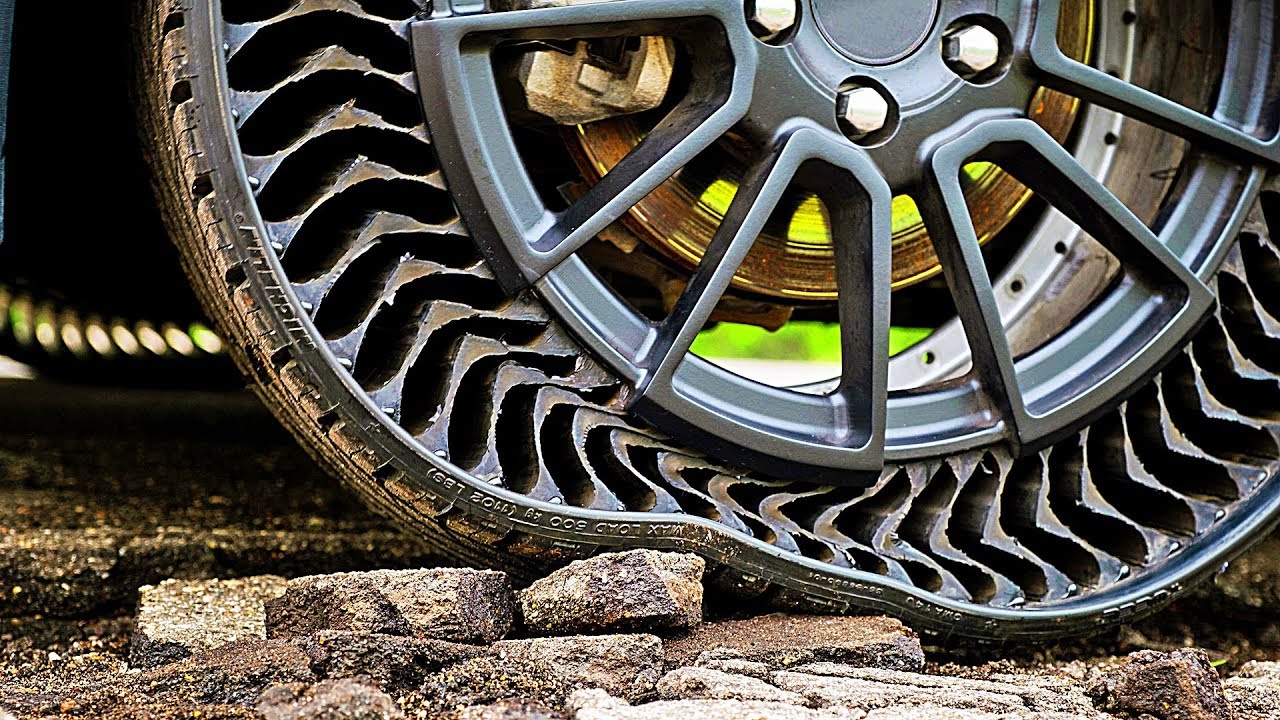
Unlike their pneumatic predecessors, airless tires are monolithic structures. They forgo the pressurized cavity in favor of a sophisticated, integrated design that provides support, cushioning, and durability through geometry and advanced materials.
A. Core Architectural Principle: The central innovation is a repeating, flexible structural pattern often a web or honeycomb that forms the tire’s interior. This structure is sandwiched between a solid outer tread band (for contact with the road) and a rigid inner ring (which attaches to the wheel hub).
B. The Magic of the Flexible Structure: As the tire rotates and encounters bumps, the patterned structure deforms compressing and flexing to absorb impacts and shocks, mimicking the function of air compression in a traditional tire. After the deformation, the material’s elasticity returns it to its original shape.
C. Material Science Breakthroughs: Early airless tires used rigid plastics, resulting in a harsh ride. Today’s next-gen versions utilize advanced, proprietary composites, polyurethane resins, and hybrid materials engineered for exceptional flexibility, fatigue resistance, and resilience. Some integrate recycled plastics and rubbers into their matrix, boosting sustainability.
D. Tread Integration: The outer tread is not a separate layer but is often bonded or integrally molded with the supporting structure. It can be replaced or retreaded in some commercial designs, extending the product’s lifecycle significantly.
C. Market Leaders and Their Commercial Offerings
The race to commercialize airless tires is led by industry titans and agile innovators, each with unique approaches.
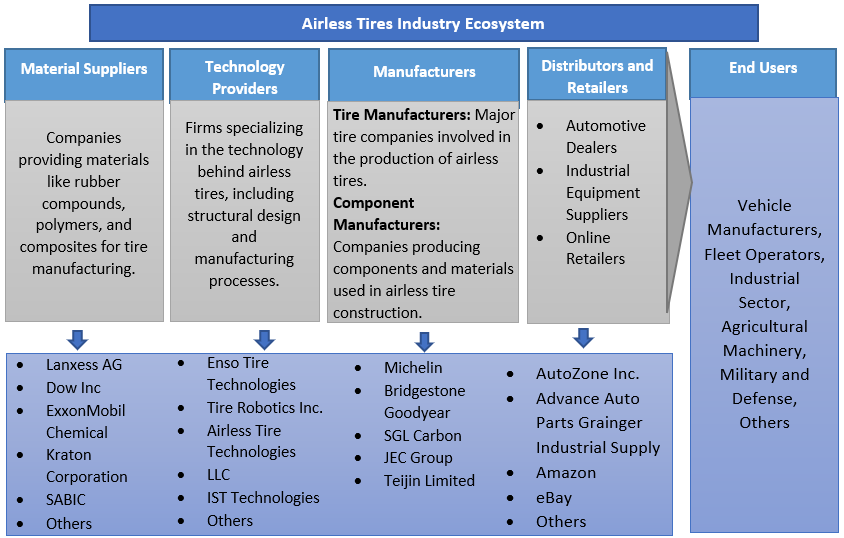
A. Michelin – The Uptis (Unique Puncture-proof Tire System): In partnership with General Motors, Michelin plans to debut Uptis on select GM models as early as 2024. Its distinctive open-web design uses glass-fiber reinforced plastic and a high-performance rubber tread. Michelin emphasizes sustainability, targeting a 20% reduction in raw materials and the elimination of spare tires.
B. Bridgestone – The Air-Free Concept: Bridgestone’s design features a intricate resin spoke structure radiating from the hub. It focuses on recyclability, using thermoplastic resin that can be repeatedly melted and reformed. Initially targeting low-speed urban vehicles and micromobility, they are aggressively pursuing scalability.
C. Hankook – iFlex: Hankook has tested its iFlex design, notable for its high-density spoke pattern, achieving impressive results in speed, durability, and load-bearing tests, signaling readiness for passenger vehicle adoption.
D. Specialized Niche Players: Companies like Amerityre have long produced polyurethane foam-filled tires for industrial applications. Tweel (a portmanteau of “tire” and “wheel”) by Michelin is already commercially available for skid-steer loaders, lawnmowers, and all-terrain vehicles, proving the technology’s robustness in demanding sectors.
D. Multifaceted Advantages Beyond Just No Flat Tires
The benefits of airless tires extend far beyond mere puncture resistance, offering systemic improvements across safety, operations, and ecology.
A. Uncompromised Safety and Reliability: The elimination of blowouts and sudden pressure loss is a monumental safety leap. This is critical not only for passenger cars but for high-speed pursuits in law enforcement, remote medical evacuations, and military operations where failure is not an option.
B. Dramatic Reduction in Maintenance: Fleet operators and everyday drivers will no longer need to schedule pressure checks, rotations for uneven wear (as wear patterns differ), or emergency roadside services for flats. This translates to substantial cost savings and increased vehicle uptime.
C. Extended Service Life and Durability: The robust construction inherently resists cuts, cracks, and damage from curbs or potholes. While the tread will eventually wear, the core structure lasts significantly longer than a conventional tire carcass.
D. Environmental Sustainability: The long-term vision is powerful:
1. Resource Reduction: No spare tires, jacks, or tire repair kits needed in vehicles, reducing manufacturing overhead.
2. Enhanced Recyclability: Many designs use single-material families or easily separable materials, simplifying recycling.
3. Waste Minimization: With retreadable treads and longer overall life, fewer tire units enter the waste stream annually.
E. Consistent Performance: Vehicle handling and fuel efficiency remain constant, as there is no risk of under-inflation degrading performance over time.
E. Current Challenges and Hurdles to Universal Adoption
Despite the promise, next-gen airless tires face technical and market hurdles that must be overcome for widespread passenger vehicle use.
A. Ride Comfort and Noise at High Speed: Refining the harmonic damping of the structural web to match the supremely quiet and smooth ride of high-end pneumatic tires, especially at highway speeds above 70 mph, remains an engineering focus. Noise from air movement inside the structure can be an issue.
B. Heat Dissipation: Pneumatic tires dissipate heat generated by friction through air movement inside the tire. Airless designs must manage this heat through material science and structure design to prevent material degradation over long, high-speed journeys.
C. Weight Considerations: Some current prototypes are heavier than their pneumatic counterparts, which can negatively impact unsprung mass, handling agility, and potentially energy efficiency in electric vehicles where range is paramount.
D. Consumer Mindset and Cost: The initial purchase price will be higher. Educating consumers on the long-term total cost of ownership savings on maintenance, fuel, and tire replacements is crucial. The visual appearance, being different, also requires consumer acceptance.
E. Manufacturing Scalability: Retooling massive, global tire factories from producing layered pneumatic tires to molding or printing monolithic airless structures represents a multi-billion dollar investment and a significant logistical challenge.
F. Diverse Application Sectors: Beyond the Passenger Car
The initial rollout and most immediate benefits will be seen in sectors where downtime is costly or operational environments are extreme.
A. Shared and Urban Micromobility: E-scooters and e-bikes suffer chronically from punctures. Airless tires are a perfect, low-maintenance solution for shared fleets, ensuring constant availability and reducing operational costs.
B. Commercial and Logistics Fleets: Delivery vans, postal vehicles, and taxi services operating 24/7 cannot afford downtime. Airless tires guarantee maximum fleet on-road availability, directly boosting profitability.
C. Agricultural and Heavy Machinery: In environments rife with piercing hazards (thorns, metal debris), airless tires on tractors and harvesters prevent work stoppages during critical seasons.
D. Military and Emergency Services: The original proving ground. Airless tires ensure tactical vehicles and ambulances are never immobilized by enemy fire or debris in disaster zones, saving lives and completing missions.
E. Space Exploration: NASA has developed and tested airless tire concepts for lunar and planetary rovers, where extreme temperatures and abrasive terrain make pneumatic tires impossible.
G. The Future Roadmap: Integration with Smart Mobility
Airless tires are not an isolated innovation; they are a foundational component for the future of transportation.
A. Synergy with Electric and Autonomous Vehicles (EVs/AVs): For autonomous robotaxis and delivery bots, the absolute reliability and zero-maintenance promise of airless tires is essential for profitable, unattended operation. For EVs, the consistent rolling efficiency aids in maximizing range prediction algorithms.
B. Embedded Sensor Technology: The solid structure provides an ideal platform to embed sensors for real-time monitoring of tread wear, temperature, and road conditions (friction, wetness), feeding data directly to the vehicle’s ADAS (Advanced Driver-Assistance Systems) and cloud for fleet management.
C. Customization and On-Demand Treads: Future iterations could allow drivers to swap or upgrade the outer tread band for different seasons (snow, rain) or activities (off-road, track), while keeping the core wheel structure for years.
D. Evolution of Vehicle Design: Without the need for spare tire wells, jack storage, or tire pressure monitoring systems, automakers gain valuable space for larger batteries, more cargo room, or innovative interior designs.
Conclusion
The arrival of next-generation airless tires on the commercial market marks a definitive turning point in mobility history. It is a transition from a fragile, maintenance-intensive system to one of resilient, sustainable, and intelligent durability. While challenges in refinement and scaling persist, the trajectory is clear. From ensuring an e-scooter ride isn’t cut short by a thorn to guaranteeing a family’s cross-country journey isn’t interrupted by a blowout, and from empowering farmers to feeding the data needs of self-driving cars, airless tire technology is poised to roll into every facet of our transported lives. This is not merely an incremental upgrade; it is a foundational re-engineering of the wheel itself, setting the stage for a safer, more efficient, and less wasteful future on the road. The revolution is no longer just in the lab or on the battlefield it is here, and it is rolling steadily toward a dealership near you.